Introducing Genji-e (The Tale of Genji)

When we speak of “Genji-e”, we refer to paintings based on The Tale of Genji, a work of literature that is exceptionally well known in Japan.
In this article, I would like to briefly introduce how The Tale of Genji has been expressed in the form of ukiyo-e prints.

What Is Genji-e?

With the development of woodblock printing in the Edo period, works depicting The Tale of Genji began to appear. Genji-e in ukiyo-e can be broadly divided into two types: illustrations that faithfully follow the original story, and “mitate-e”, or parody/analogy pictures, in which the subject is reimagined as something else.

The earliest versions of The Tale of Genji, created in the mid-Heian period, consisted only of text and contained no illustrations. Toward the end of the Heian period, the Genji Monogatari Emaki (Illustrated Handscrolls of The Tale of Genji) were produced; however, these were hand-painted manuscripts rather than woodblock prints. Because each copy had to be reproduced by hand, they required an enormous amount of time and labor to create and were not items that ordinary people could easily obtain.

Against this background, illustrated printed editions of The Tale of Genji published in the Edo period—known as Eiri Genji Monogatari—appeared. These editions included illustrations, were easier to understand, and were far more accessible to general readers. In addition, apart from Eiri Genji Monogatari, several ukiyo-e artists of the Edo period produced numerous works inspired by the courtly world of The Tale of Genji.

On the other hand, depictions that do not portray the story as it is, but instead replace the characters with figures resembling common townspeople of the Edo period, are known as mitate-e. Strictly speaking, however, these works are not based directly on Eiri Genji Monogatari, but rather on Nise Murasaki Inaka Genji.

Nise Murasaki Inaka Genji, written by Ryūtei Tanehiko, is an adaptation of The Tale of Genji that follows its general storyline while reworking it as a tale of family conflict set in the Muromachi period. The work became immensely popular among Edo townspeople and was a major bestseller. It was written over a span of fourteen years, but came to an end at volume 38 (152 booklets) due to the author’s literary persecution and subsequent death. In addition to the novel itself, numerous ukiyo-e prints based on Nise Murasaki Inaka Genji were published.

This time, we had the opportunity to purchase examples of the latter type—mitate-e—and would like to introduce them here.

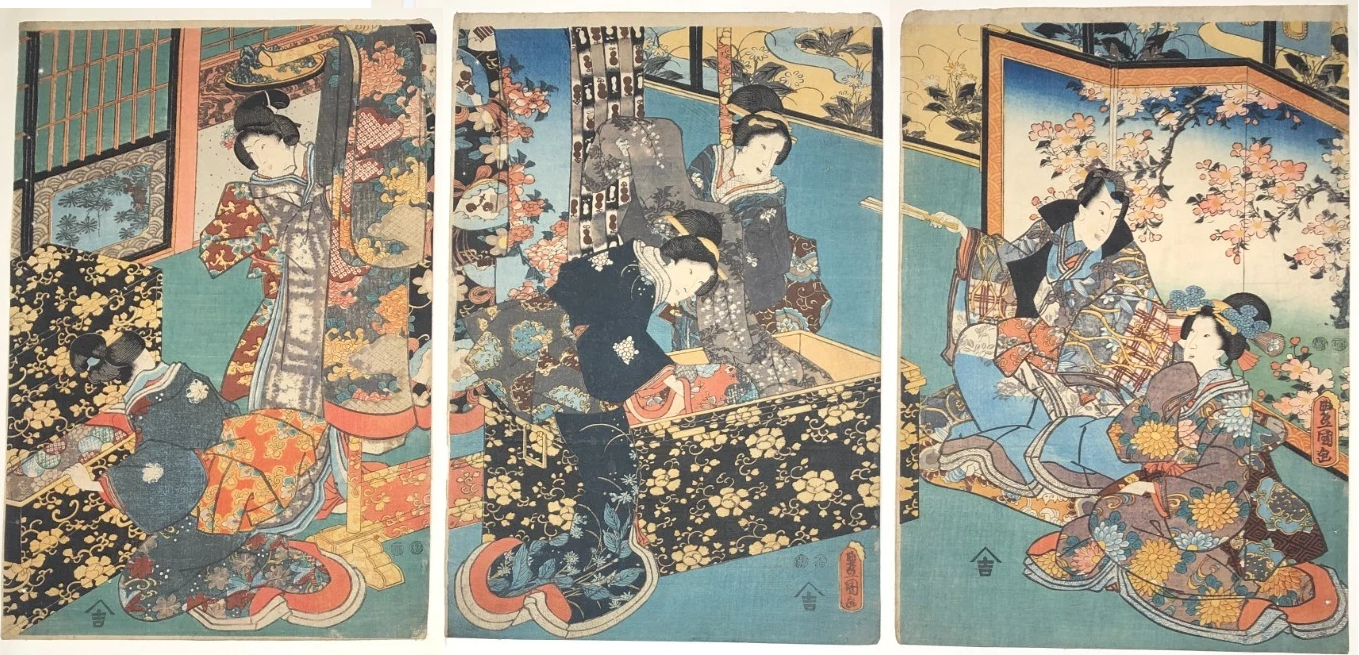
Toyokuni III – Mushiboshi (Air-Drying Garments)

This scene depicts garments being taken out of a chest, hung up, and aired.

Although I am by no means an expert on The Tale of Genji, the text contains many descriptions related to the management of clothing and seasonal attire, including references to changing garments, preparing outfits, and the colors of clothing. However, the vivid kimono seen here evoke an atmosphere that feels unmistakably Edo in character.

The obi are wide, and the kimono are not composed of the many layered “strata” seen in The Tale of Genji, but instead feature bold, clearly defined, and decorative patterns. The hair is tied up high and adorned with numerous hairpins and combs—an appearance that perfectly embodies the image of women in the Edo period.

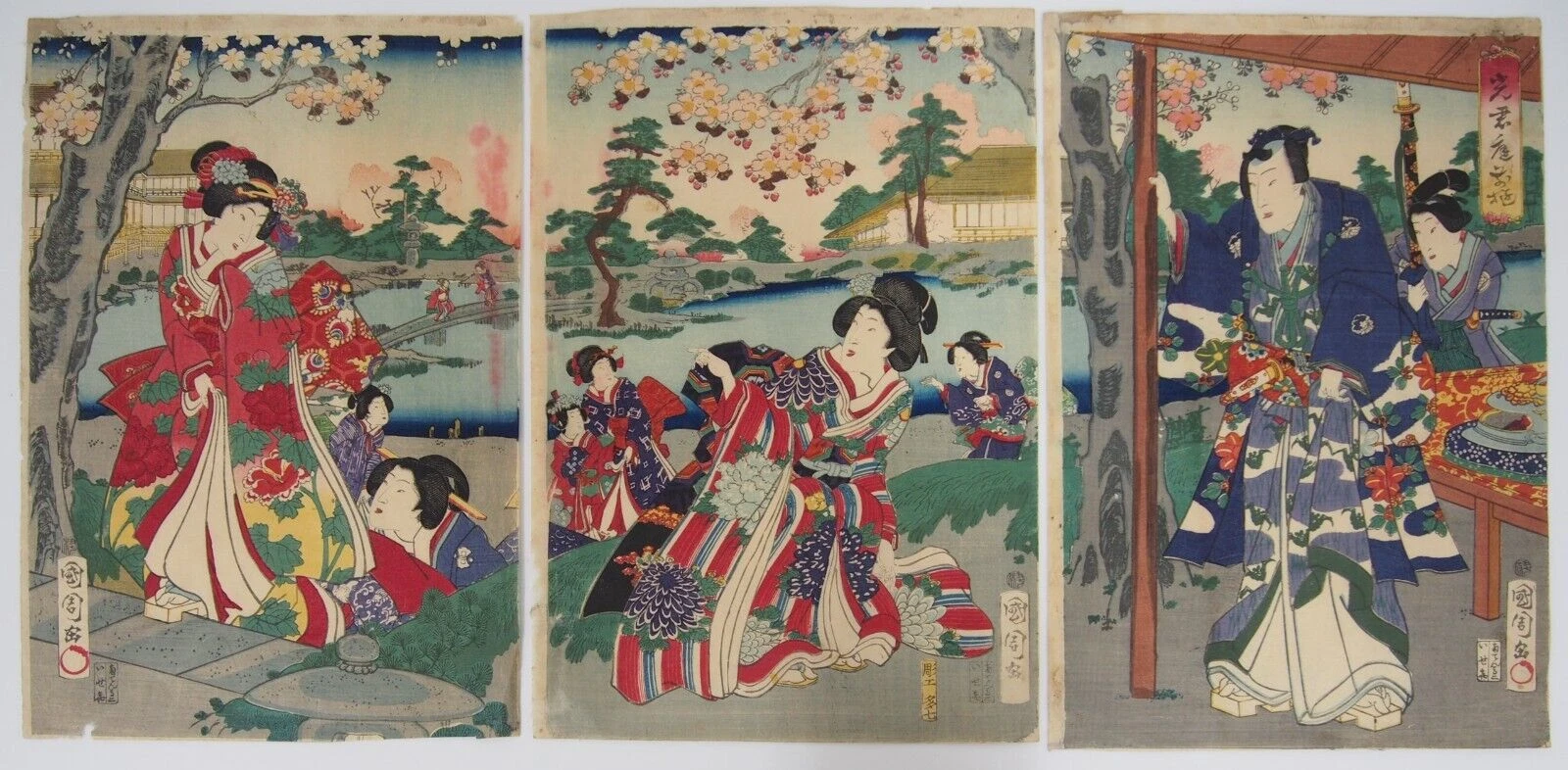
Toyohara Kunichika – Hikaru-kun Garden Amusement

Here as well, the subject matter strongly conveys an atmosphere that is distinctly Edo in style.

Within the grounds, walking paths extend throughout the garden, and the scene depicts people strolling about, crossing bridges, visiting teahouses, and enjoying cherry-blossom viewing.
It can truly be described as a landscape that reflects the customs and everyday life of the Edo period.


Both of these works employ expressions that reinterpret the subject matter in an Edo-period manner. It is precisely this kind of approach that defines what is known as mitate-e.

See more example of work through which you can experience the world of Genji-e here.

- J

Back to list

コメントを残す

コメントは公開前に承認される必要があることにご注意ください。