Introducing Tattoos drawn on Ukiyo-e

Tattoos— also known in Japanese as irezumi or horimono.

In modern Japan, many people have negative associations with tattoos. In fact, during the Meiji period, tattooing was prohibited by law as a “barbaric custom.”

For the common people of the Edo period, however, tattoos did not necessarily represent evil or fear. They were sometimes admired as symbols of courage, bravery, and masculinity.

The firefighters of the time risked their lives to protect the city. The sight of them stripping off their clothing at the scene of a fire and revealing magnificent dragon tattoos as they battled the flames made them figures of admiration among the people of Edo.

In this article, we explore the close relationship between ukiyo-e and tattoos through the three works we recently acquired.

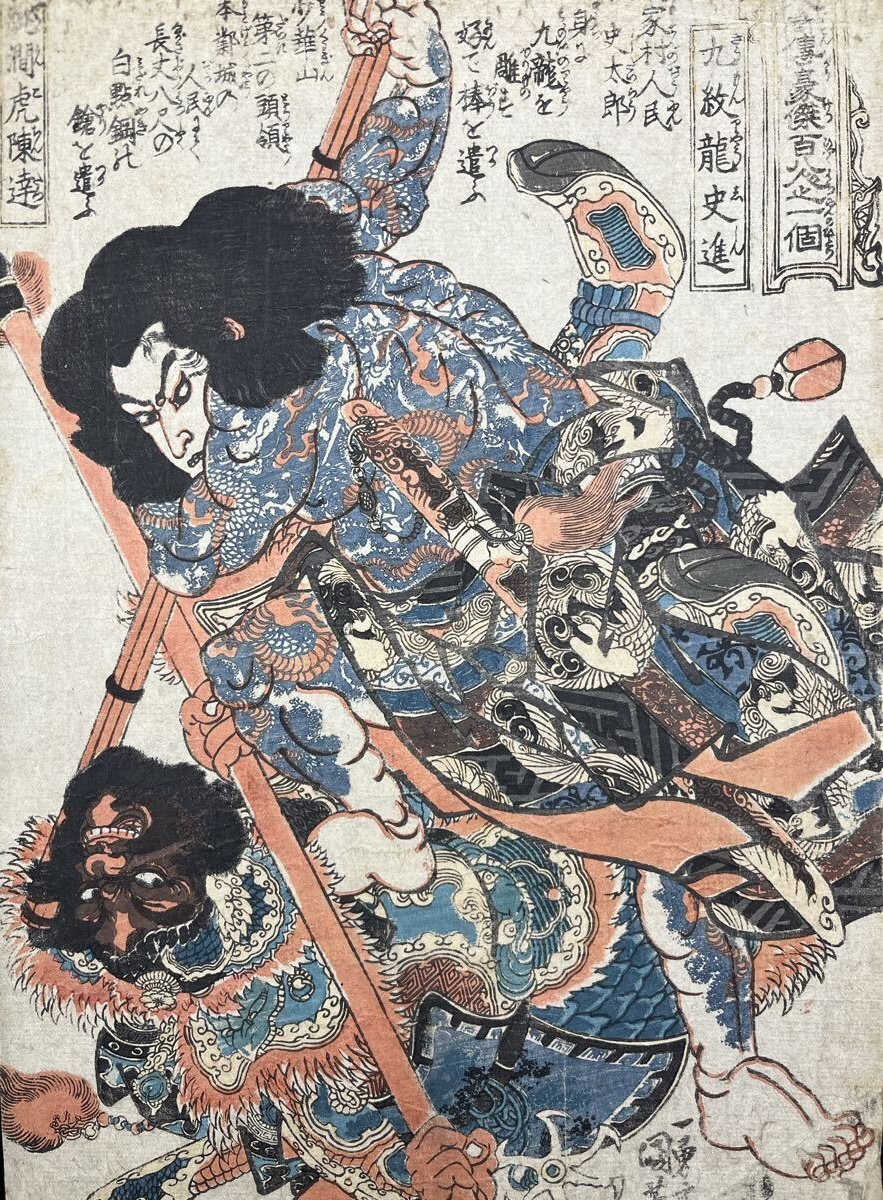
Utagawa Kuniyoshi: Shi Jin, the Nine-Dragoned, One of the 108 Heroes of the Popular Water Margin

During the late Edo period, Utagawa Kuniyoshi achieved great success with his enormously popular series "108 Heroes of the Popular Water Margin" (Tsūzoku Suikoden Gōketsu Hyakuhachinin no Hitori).

The series depicts heroes from the Chinese adventure novel Water Margin, embellished by Kuniyoshi with bold and imaginative tattoos.

Interestingly, even when reading the complete original story, descriptions of tattoos are extremely rare. Only a handful of warriors in the original novel are explicitly described as having tattoos. Kuniyoshi greatly expanded upon this element, however, depicting elaborate tattoos on more than a dozen characters.

Ukiyo-e prints were produced through a collaborative process. After an artist created the original design, a specialist woodblock carver known as a horishi carved the image into the printing blocks.

The most technically demanding task for a carver is often said to have been kewari, the carving of the extremely fine individual lines along a figure’s hairline. Carving the splashing waves and individual scales of the dragons in Kuniyoshi’s tattoo designs required a comparable level of concentration and precision.

Kuniyoshi’s tattoo designs were reportedly so intricate that the carvers complained that the blocks would not withstand such fine carving and that the work required far too much time. Nevertheless, they completed the prints with extraordinary craftsmanship and professional pride.

Representing a technical pinnacle of ukiyo-e production, Kuniyoshi’s Popular Water Margin series remains highly sought after by collectors and is among his best-known bodies of work to command high prices on today’s art market.

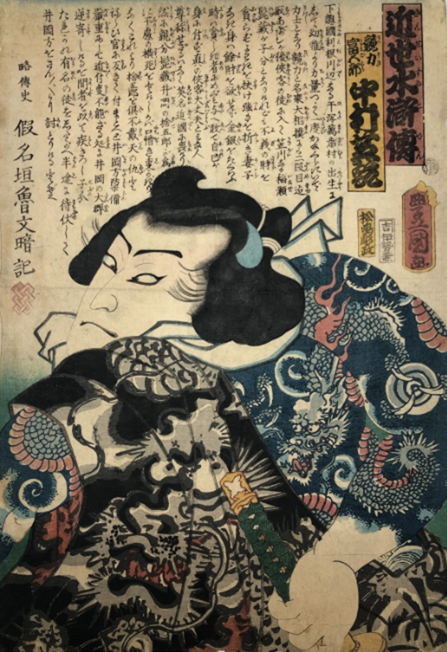
Utagawa Toyokuni: Tomigorō Competing in Strength, from the Modern Water Margin

While Kuniyoshi’s Popular Water Margin presents fantastical characters adorned with spectacular, imaginary tattoos, Utagawa Kunisada—later known as Toyokuni III—created the Modern Water Margin (Kinsei Suikoden) series by portraying real Japanese outlaws as heroes from Water Margin.

Although the title of this print identifies the figure as “Kioriki Tomigorō,” he was based on Seiriki Tomigorō, a real-life gambler and outlaw who caused considerable unrest during the final years of the Tokugawa shogunate.

Because theatrical productions and ukiyo-e prints were subject to censorship by the shogunate, the written characters in the names of real individuals were often altered slightly as a form of disguise.

The dragon, one of the most frequently depicted tattoo motifs in ukiyo-e, was an overwhelming symbol of strength. It was therefore particularly well suited to the heroic commoners who survived through their physical courage and determination, including artisans, firefighters, fishmongers, and chivalrous outlaws known as kyōkaku.

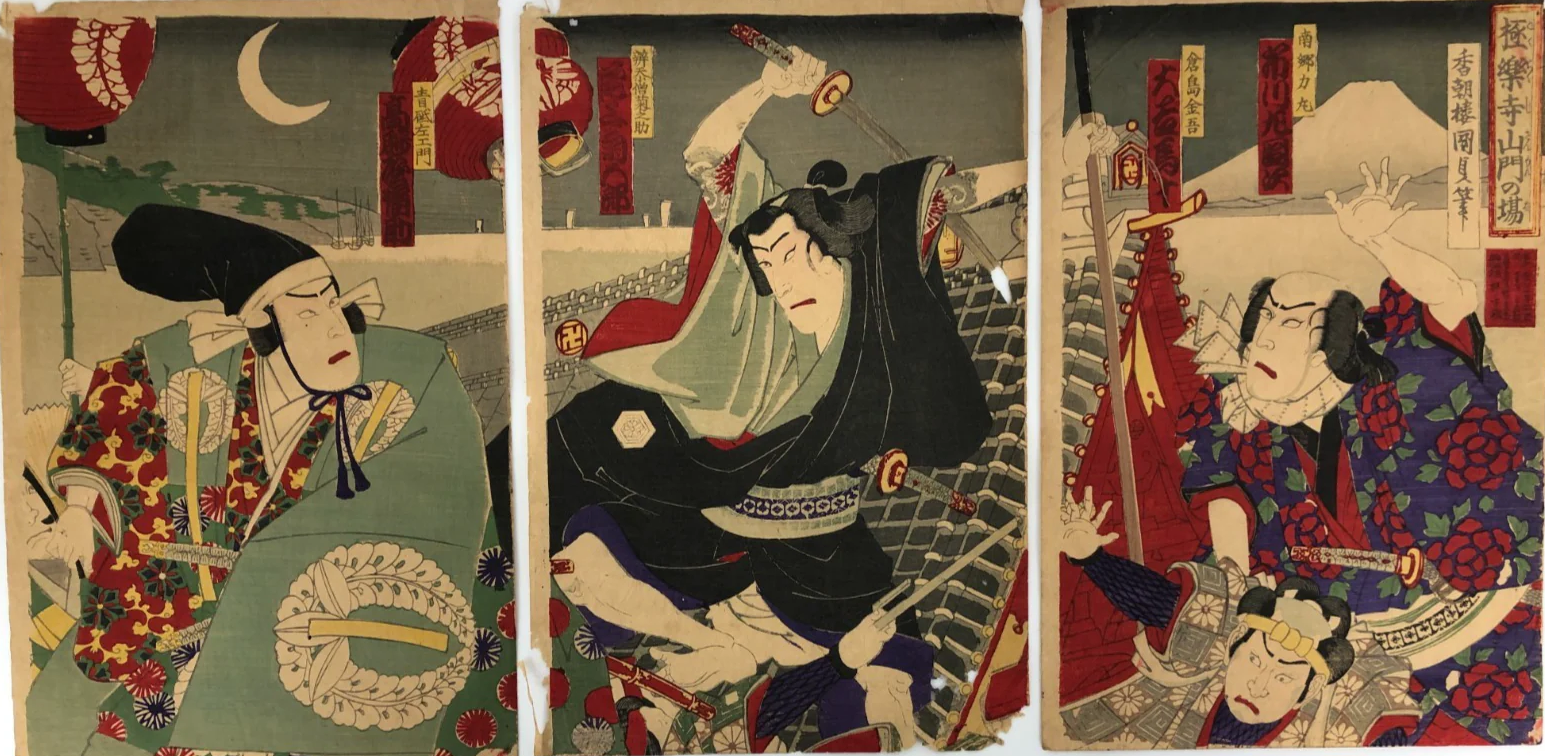
Utagawa Kunisada: The Scene at the Gate of Gokurakuji Temple

This actor print depicts the “Scene at the Gate of Gokurakuji Temple” (Gokurakuji Sanmon no Ba), a legendary scene from the kabuki theatre.

Appearing on the roof of the temple gate is Benten Kozō Kikunosuke, a notorious thief and one of the five outlaws known as the Shiranami Gonin Otoko, or “Five Thieves of the White Waves.”

Benten Kozō is portrayed as a beautiful young thief. He is especially famous for disguising himself as a woman and attempting to deceive the staff of a kimono shop. By the time of the temple-gate scene, however, his true identity has already been exposed and he has been cornered by the authorities.

Prepared to face his death, Benten Kozō throws open his kimono and launches into one final spectacular fight. This dramatic confrontation is the principal highlight of the scene.

As his clothing falls open, his tattoo is revealed.

Naturally, the tattoo displayed by the kabuki actor onstage was not real. The actor wore a special flesh-colored stage garment painted with tattoo designs, known as a nikujuban.

From the late Edo period through the Meiji period, large numbers of actor prints were created showing performers in these tattooed costumes, using the bold designs to convey an intimidating and powerful presence.


See more example of work through which you can experience the world of tattoo here.

- J

Back to list

コメントを残す

コメントは公開前に承認される必要があることにご注意ください。